
Woodbridge
22 Church Street, Woodbridge,
Suffolk
IP12 1DH
Tel: 01394 388411
Disabled access and limited disabled parking available on request
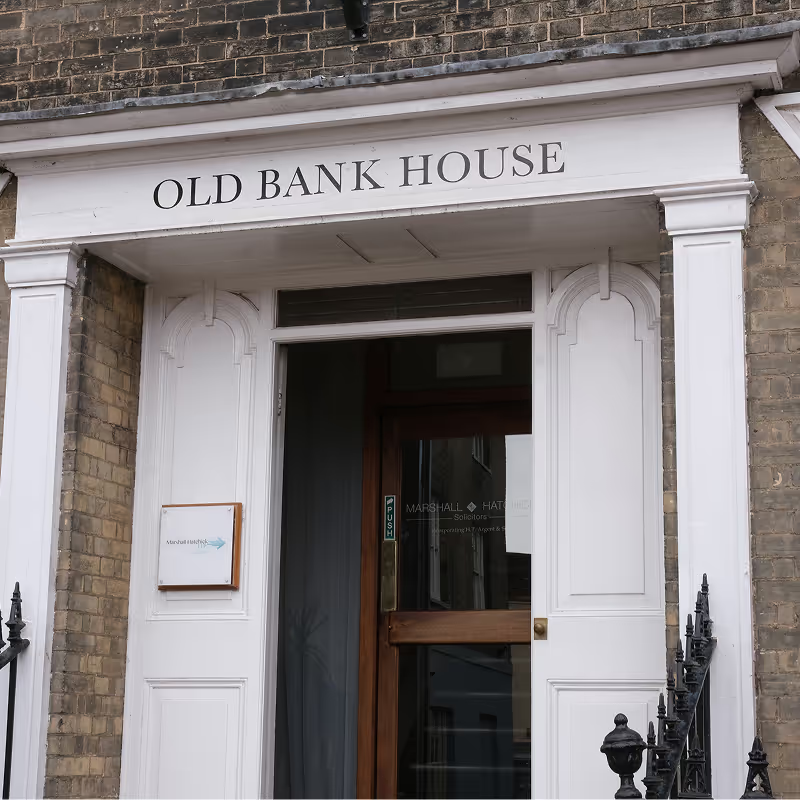
Saxmundham
Market Place,
Saxmundham,
Suffolk
IP17 1EL
Tel: 01728 602323
Disabled access and limited disabled parking available on request

Financial Remedy Proceedings Deal With How Finances Are Divided
When a marriage/civil partnership breaks down, sorting out finances can feel overwhelming. Financial remedy proceedings are the legal process used to resolve financial arrangements following separation or divorce, helping both parties move forward with clarity and security.
Not every case ends up in court. Many financial settlements are resolved by agreement, but where this is not possible, the court can step in to make a fair financial settlement.
What Are Financial Remedy Proceedings?
Financial remedy proceedings deal with how finances are divided This can include:
- The family home and other property (in the UK or abroad).
- Savings and investments
- Pensions
- Business interests
- Debts
- Ongoing financial support (maintenance)
Reaching an Agreement by Consent
Many separating couples are able to agree financial arrangements without contested court hearings. This can be quicker, less stressful, and more cost-effective.
Agreements may be reached through direct discussions, solicitor negotiations, or mediation. Once an agreement is reached, it is important that it is legally binding. This is done by preparing a consent order and submitting it to the court for approval.
Why a Consent Order Matters
A consent order:
- Makes the agreement legally enforceable
- Provides certainty and finality
- Protects against future financial claims
When Court Proceedings Are Necessary
Sometimes an agreement cannot be reached by consent. In these cases, financial remedy proceedings allow the court to decide how finances should be fairly divided.
The court process typically involves:
- Financial disclosure by both parties
- Court hearings to narrow issues and encourage settlement
- A final hearing where a judge makes a binding decision
What Does the Court Consider?
The court will consider factors such as:
- Income, assets, and earning capacity
- Financial needs and responsibilities
- Age of the parties and standard of living during the relationship
- Length of the relationship
- Contributions made by each party
- The needs of any children
What types of order can the court grant?
Financial provision orders:
Lump sum
The court can make a lump sum order which orders one party to pay the other a fixed amount of money (eg £50,000) (sometimes paid by instalments or as a series of lump sums).
Property adjustment order
This is an order transferring property from one party to another, or to a child of the family. This could include transferring assets such as the family home, car or shares in a business.
Order for sale
The court can order a party to sell specified property which the other party is beneficially entitled to. Quite often, this will be the family home. The proceeds of sale are then divided between the parties in accordance with the court order.
Pension orders
This may include a pension sharing order or alternatively a pension attachment order.
Maintenance
These orders can include an order for periodical payments, which are regular maintenance payments from one party to the other. An order for periodical payments can be specified to last until the other party remarries, passes away (known as a joint lives order) or it may be made to finish on a particular date (known as a term order).
Clean break order
This confirms that there are no ongoing financial ties between a separating couple. A clean break order prevents any future claims from being brought.
Next Steps:
Our Family Law Team at Marshall Hatchick provide clear, practical advice whether you are formalising an agreement or dealing with contested proceedings. Our focus is on achieving fair outcomes while reducing conflict and protecting your long-term financial security.
To make the process less stressful, we offer a confidential one hour initial consultation for a fixed fee of £165 + VAT.
Contact us on 01394 388 411 or email: michelle.chemli@marshallhatchick.co.uk



Accreditations



%201.svg)

.svg)

