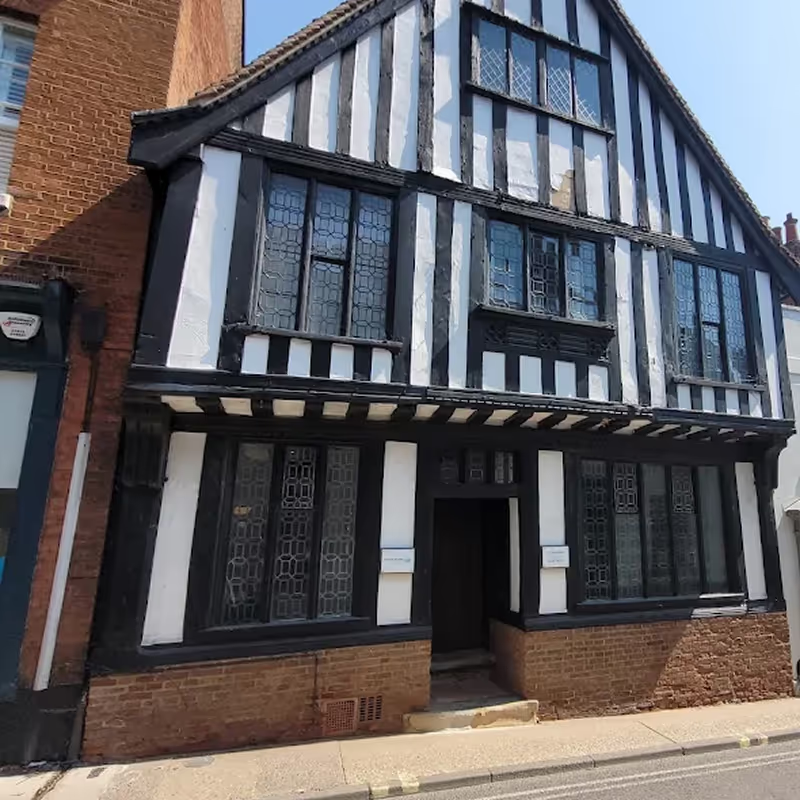
Woodbridge
22 Church Street, Woodbridge,
Suffolk
IP12 1DH
Tel: 01394 388411
Disabled access and limited disabled parking available on request

Saxmundham
Market Place,
Saxmundham,
Suffolk
IP17 1EL
Tel: 01728 602323
Disabled access and limited disabled parking available on request

Support When The Unexpected Arises
Dispute Resolution covers a range of options to resolve disputes, including litigation, which is formal court action but it also includes a range of different methods which may be used as an alternative to reach a settlement. These alternative methods are known as Alternative Dispute Resolution (ADR). Read our Alternative Dispute Resolution document (PDF, 293KB).
Common issues we regularly deal with include: -
Property
- Landlord and Tenant – Landlord and Tenant Act 1954 advice re. lease renewal
- Dilapidations – commercial tenancies establish who is obliged under the terms of the lease to carry out repairs to different parts of the leasehold premises. When the lease comes to an end, it may well be that the tenant has not complied with its obligations to repair the property to the condition required under the terms of the lease and the landlord will seek a claim in dilapidations to cover the costs of doing so and recovering those from the tenant. The area is governed by a pre-action protocol in advance of formal court proceedings which sets out the approach which should be followed with the aim of avoiding court action.
- Possession – action by a landlord to recover possession of a commercial leasehold property commonly often at the end of a fixed term tenancy or where there has been a breach by the tenant of its covenants. The most common forms of breaches are for failure to pay rent or failure to effect repairs.
- Forfeiture – a landlord has an option to bring the lease to an end either if the rent remains unpaid or if other terms of the tenancy have not been complied with by the tenant. For non-payment of rent, a landlord can only forfeit if there is a provision in the lease and if rent remains unpaid for the minimum period established in the lease. Forfeiture can be conducted either by peaceful re-entry during the hours of sunrise and sunset or more reliably by court application. It is important to take legal advice if a landlord is seeking to recover the property by forfeiting the lease for non-payment of rent.
If a tenant has received an application for forfeiture or the locks have been changed by peaceful re-entry, a tenant can apply to the court for relief against forfeiture.
Forfeiture can also occur if certain terms of the lease have not been complied with. It is usual that the landlord must serve the tenant with a statutory notice which requires the necessary steps to be taken to comply with the terms of the lease within a fixed period of time, failing which, the landlord can seek to forfeit.
- Squatters occupying commercial premises - it is important to take the right steps to look to remove squatters and secure premises.
- Schedules of condition.
Contractual
- Enforcement of commercial terms.
- Disputes with other business.
A business is likely to become involved in a dispute at some point, usually where a customer has not paid, disputes the quality of goods or services, has an issue with premises, including dealing with its lease or a dispute with a supplier. Like it or not we are governed by contracts — terms of business, usual conduct with suppliers, standard written terms and the like.
If dealing with consumers, as most businesses do, you are also governed by Consumer Rights legislation which implies terms into contracts with businesses for the benefit of consumers as well as limiting a business' ability to rely on unfair contract terms and onerous conditions in the 'small print'.
Our advice is to take advice early in order to understand the law as it applies to you, with the aim of resolving a dispute as soon as possible. Legal costs are rarely included in a budget but it is important to understand the nature of the dispute to know if you can recover any costs at all, if those might be fixed recoverable costs or if you will need to appoint an expert costs drafter to prepare a budget for anticipated costs.
At the outset we will address with you the prospects of success, including the very practical consideration of your ability to recover a claim and/or costs. You might have a great case but if your opponent has no funds, you are simply further out of pocket to obtain a judgement you cannot enforce.
If you need advice please contact Rachel Cronin, Head of Dispute Resolution.



Accreditations



%201.svg)

.svg)

